Licensing · Private land · 2026
NewA towable food trailer on private land in 2026: what applies and what you need
A practical guide to land use, notification, required documents, and the planning-permission question for a towable food trailer.
Last updated: September 19, 2026
A towable food trailer on private land: the key steps and conditions for 2026.
A towable food trailer on private land is a solution more and more business owners are choosing, but the fact that the land is private doesn't mean the installation can go ahead without any checks. Since July 23, 2026, a specific framework has applied to mobile food trailers on private land, with its own notification procedure and specific required documents.
For a towable food trailer, the right approach is to first check the location and the land uses, and only then put together the installation file. The food trailer keeps its character as a towable vehicle for as long as it remains capable of being towed and is not, in practice, turned into a permanent structure.
1. Can a towable food trailer be placed on any private land?
No. The new framework provides that a mobile food trailer on private land is allowed in areas where, in land-use terms, "catering" and "refreshment" uses are permitted. Before the operating notification, a certificate under paragraph 2 of Article 28 of Law 4442/2016 is required for the specific location.
The application is submitted to the competent Municipality and includes, among other things, the applicant's details, the activity and its business-activity code (ΚΑΔ), a full description of the property's location, and a sketch or map showing the exact installation point.
In practice, this is the first step to take before spending money on fit-out, equipment or works at the site.
2. What applies regarding wheels, fixing to the ground, and a building permit?
This is where particular care is needed, because the oversimplified view that "since it has wheels, nothing is needed" is common. The Spatial Planning and Urban Development Code (Law 5306/2026) defines a "building work" as a structure that is permanently attached to the ground, cannot move under its own power, and cannot be towed. This is a significant factor when the food trailer keeps its wheels, its vehicle registration document and a genuine ability to be towed, and is not fixed to the ground.
However, ΚΥΑ 61788/2026 includes a planning-related document among the required documents for a mobile food trailer, and sets out a specific procedure for when a building permit is not required. For this reason, for a towable food trailer it is not safe to automatically assume that the planning requirement is reduced to zero just because it has wheels. The right approach is for an engineer and, where needed, the competent Building Permits Department (ΥΔΟΜ) to confirm exactly which document is required for the specific installation.
If permanent structures or works are built around the food trailer — for example fixing it to the ground, a fixed canopy, walls, bases, significant ground works or other fixed infrastructure — these are examined separately. Depending on the type and extent of the work, no permit may be required, a Small-Scale Works Approval (ΕΕΔΜΚ) may be required, or a full building permit may be required. There is no general rule that every permanent structure is covered merely by a "small-scale works approval."
3. What documents are needed for a towable food trailer on private land?
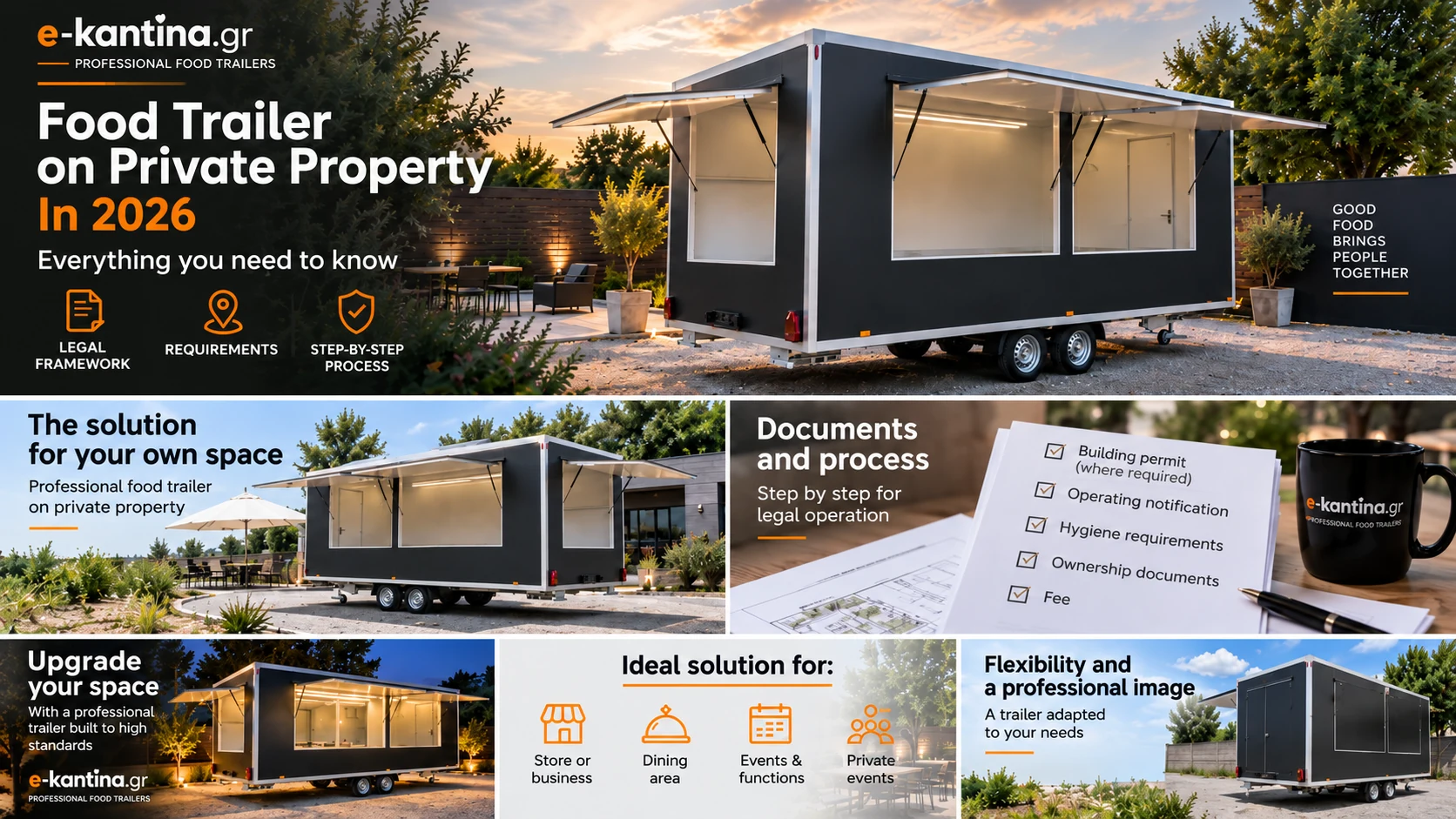
The basic documents and checks required before the operating notification.
Before submitting the notification, the food trailer's operator must have gathered, and keep on site, the documents required by ΚΥΑ 61788/2026. Not all of them apply in every case, since some depend on the location and the utilities of the installation.
The basic ones include the Article 28 certificate for the specific location, the food trailer's vehicle registration document, the required planning-related document, and — when a building permit is not required — the corresponding approval from the local Architecture Council. A sworn statement about the forestry status of the land is also required, when applicable.
Depending on the installation, you may also need an Electrician's Declaration of Compliance (ΥΔΕ) for connecting to the power grid, an engineer's statement for a traffic connection or entry/exit point, a water-use permit if water is drawn from a private source, a health-officer declaration when this is a different person from the operator, and proof of payment of the fee.
4. How does the operating notification work?
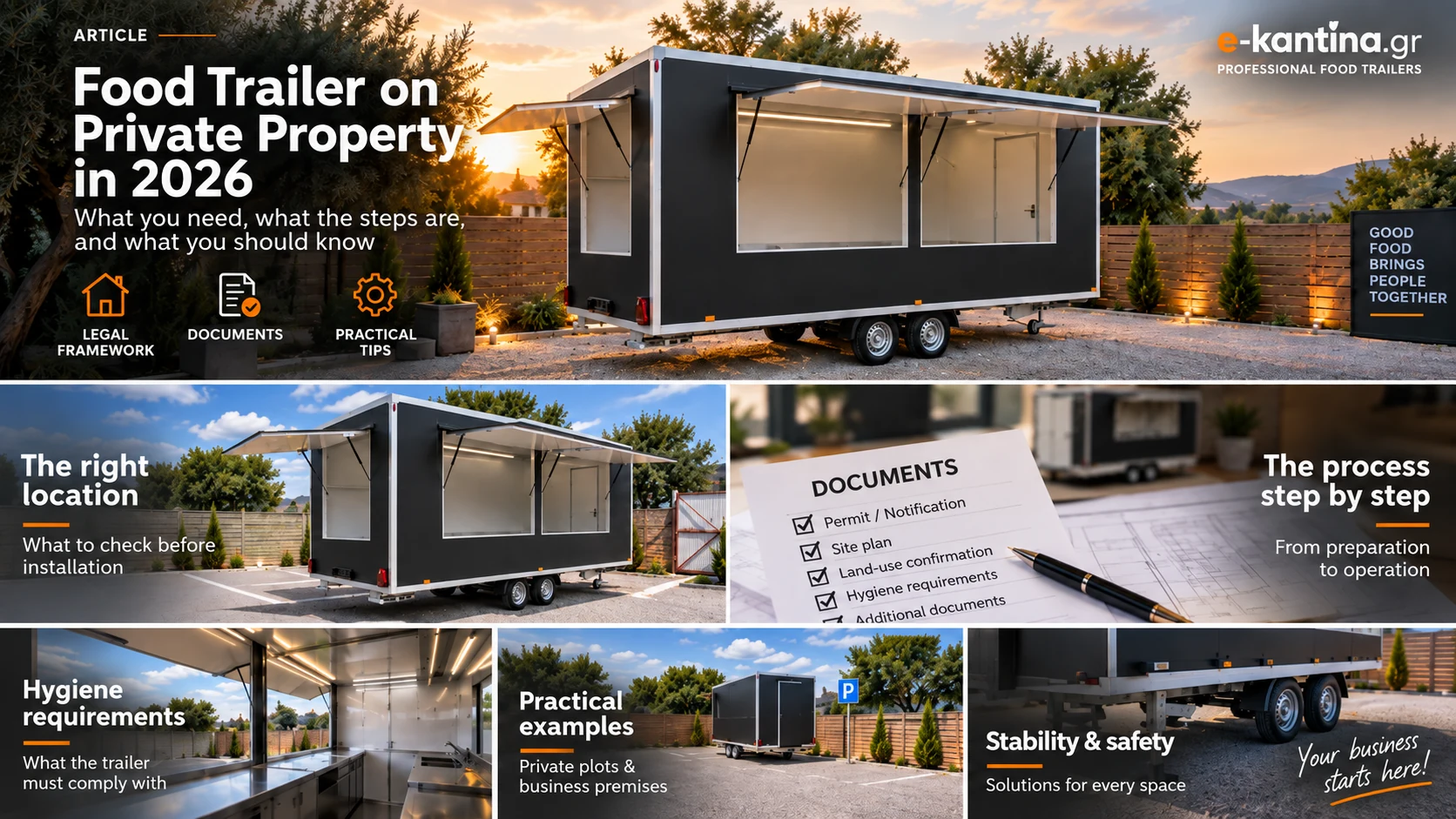
The right order: check the location, prepare the file, then notify.
Once the installation conditions have been met and the required file has been put together, the operating notification is submitted to the competent Municipality.
Based on OpenBusiness guidance available at the time this article was last updated (September 19, 2026), the specific form for mobile food trailers on private land had not yet been added to OpenBusiness. Until it is activated, the notification is submitted electronically or on paper to the competent Municipality or to a Citizens' Service Centre (ΚΕΠ) acting as a Single Service Point.
After the notification is submitted, the operator can begin operating, provided of course that all required conditions have been met and the documents that must be kept on site are in place.
5. What's the fee, and what applies to debts owed to the Municipality?
A fee of €100 applies to the initial notification. Also, on the date the notification is submitted, the operator must have no certified overdue debts to the competent Local Authority. This condition is checked by the competent authority.
6. The right order before you buy or install the food trailer
To avoid delays and unnecessary costs, the safest order is as follows:
- Choose the property and check the land uses.
- Ask the competent Municipality for the Article 28 certificate for the specific location.
- Give the property and installation details to a qualified engineer to check the planning status and any additional structures.
- Choose a towable food trailer with the necessary registration documents and plan the fit-out to match its use.
- Complete the required utility connections and any other documents that apply.
- Pay the fee and submit the operating notification to the competent authority.
- Keep the food trailer's file up to date and available for any inspection.
To work out the total cost of the investment from scratch — vehicle, documents, equipment — see our detailed guide on how much it costs to open a food trailer.
7. Why the location must be checked before fitting out the food trailer
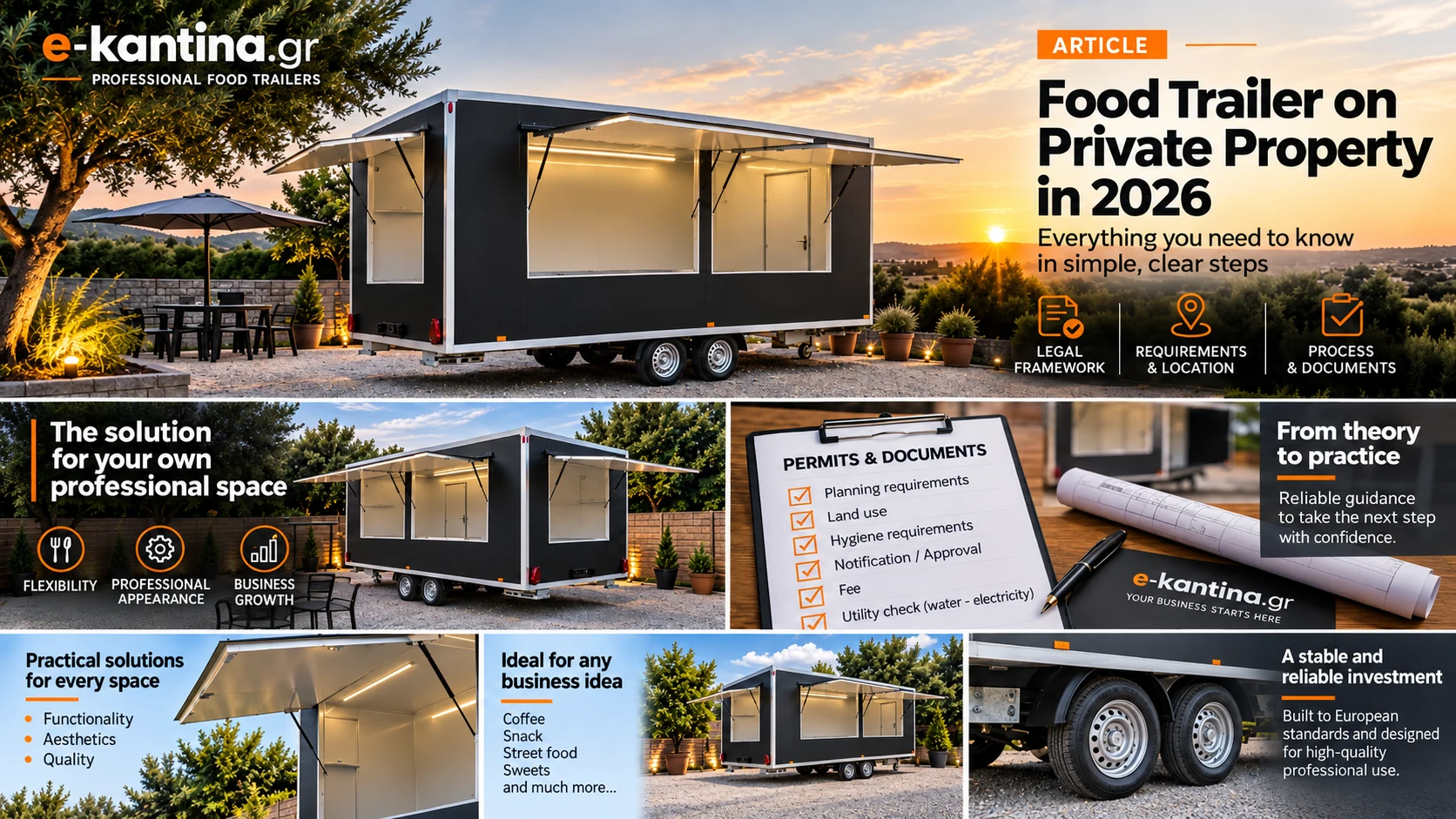
An example of a towable food trailer set up on organized private land.
Choosing the food trailer's length, windows, electrical connections, water supply and professional equipment should happen only once it's clear where and how the business will operate. A location can look practically suitable, yet still carry a land-use restriction, a traffic-connection requirement, or forestry or other special legislation.
That's why at e-kantina we recommend first confirming that installation is possible at the specific location, and only then finalizing the dimensions and professional fit-out of the towable food trailer. If you're not yet sure which length suits you, first see what size food trailer to choose.
See towable food trailers and available dimensions
At e-kantina.gr you can see towable food trailers from 3 to 7 meters, compare dimensions and plan the fit-out to match your business concept. Also see the prices of towable food trailers for all models. Before making a final choice, first confirm that the specific location can be used for the activity you're planning.
Frequently asked questions
Can I place a towable food trailer on any private plot or piece of land?
No. You need to check whether the required land uses are permitted at that specific location, and obtain the relevant certificate before submitting the notification.
Because the food trailer has wheels, does that mean no planning check is needed?
Not as a general rule. Being towable and not fixed to the ground are important factors, but the current framework still requires a specific planning-related document. The engineer and, where needed, the Building Permits Department (ΥΔΟΜ) must confirm what's required for your specific location.
If I add a concrete base, a canopy or another permanent structure, do I need a small-scale works approval?
It depends on the specific work. Some work may need no approval at all, some falls under a small-scale works approval (ΕΕΔΜΚ), and some requires a full building permit. The category is determined by an engineer according to the legislation and the characteristics of the property.
Does the towable food trailer need a vehicle registration document?
Yes. ΚΥΑ 61788/2026 includes the food trailer's vehicle registration document among the documents kept on site.
Can I connect the food trailer to power and water?
Utility connections can be arranged, but they create corresponding technical and administrative obligations. Connecting to the power grid requires, where applicable, an electrician's declaration (ΥΔΕ). Drawing water from a private source requires a water-use permit.
How much does the notification cost?
The fee for the initial notification is €100, under ΚΥΑ 61788/2026.
Is the notification the same as an operating licence?
The procedure works on a notification basis. That doesn't mean the conditions or documents are bypassed: the required checks must already have been carried out, and the file must be complete and available for inspection.
See the technical specifications of every e-kantina.gr model (3 to 7 meters) and find the one that fits your space and your activity.
See the CatalogLegislation and sources used
- ΚΥΑ 61788/2026, Government Gazette Β' 4549/23.07.2026 — notification procedure for mobile food trailers on private land, Articles 3, 4, 6, 7 and 10 (in Greek).
- Law 4442/2016, in particular Article 28 and the framework for mobile food trailers as amended in 2026 (in Greek).
- Law 5306/2026, Government Gazette Α' 88/08.06.2026 — Spatial Planning and Urban Development Code, Article 197 item 16 ("building work") and Articles 284 et seq. on land use (in Greek).
- OpenBusiness Portal – FAQs "Food Trailers" (in Greek)
- ΚΥΑ 61788/2026 – full text (in Greek)
- Law 5306/2026, Article 197 (in Greek)