How to Set Up a Street Food Trailer: Sandwiches, Grilled Food and Equipment
The success of a street food trailer depends on a focused menu, safe workflows and professional equipment that genuinely fits the available space.
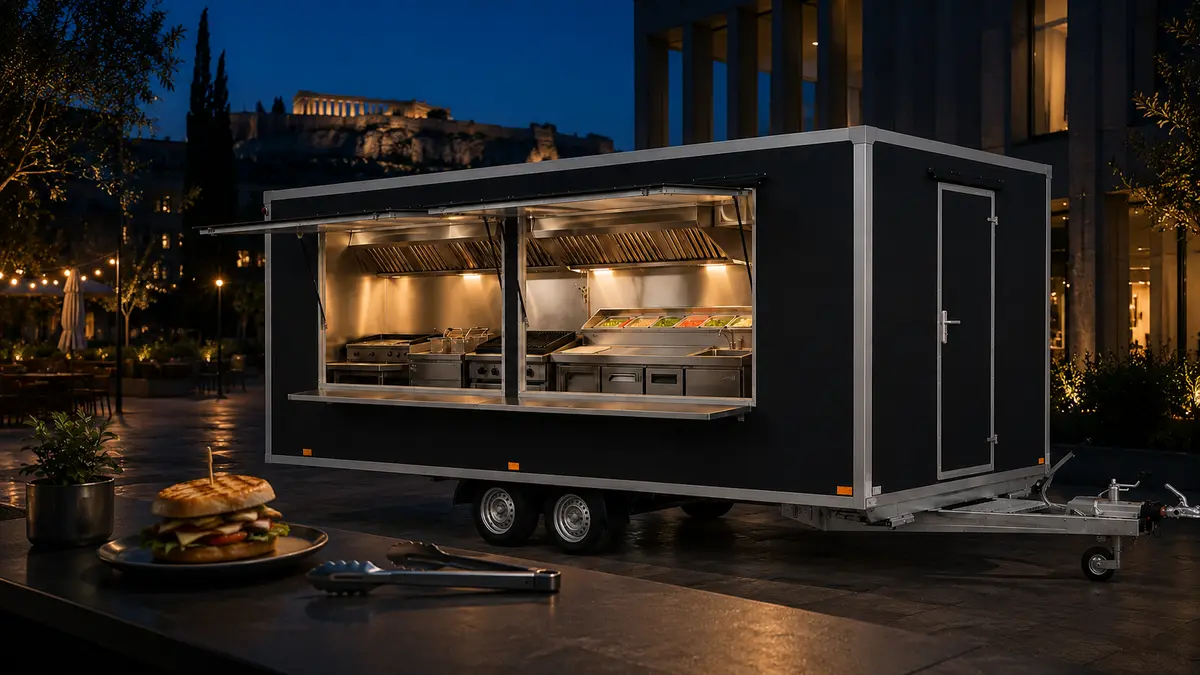
1. The menu shapes the entire street food trailer
A sandwich food trailer doesn't necessarily need the same kitchen as a burger, souvlaki or grill food trailer. Before deciding on dimensions, write down exactly what you'll offer, which ingredients are prepared on site, what arrives ready-made, and how many orders you want to handle during peak hours.
A menu built around cold sandwiches relies more on proper refrigeration, clean prep and fast assembly. A grill or burger food trailer, on the other hand, needs suitable heating equipment, well-planned ventilation and a safe separation between raw ingredients and finished products.
The best starting point is a short, focused menu that can be executed consistently. The more different preparations you add, the more space, utilities, storage and cleaning you'll need.
2. What equipment a sandwich or grill food trailer needs
Heating equipment and preparation
Depending on the menu, the mobile kitchen may need a professional griddle, grill, fryer, heated surface or another suitable appliance. Final choices should only be made once you've checked the available surface, weight, utility connections and safe-operation requirements.
Ventilation or extraction must be planned by a qualified technician, based on the type of appliances and the rules that apply to that specific installation. It isn't enough to simply place a machine in an empty corner.
Refrigeration, stainless steel counters and storage
Ingredients need proper storage and temperature control appropriate to their use. A professional under-counter refrigerator or a chilled ingredient display case can significantly improve workflow, as long as it matches the menu's actual needs.
The stainless steel counters, cabinets and sinks allow for tidy organization and easier cleaning. Also plan space for packaging, dry goods, tools, waste and safe handling of used materials, depending on the activity.
Note: griddles, fryers, refrigerators, extraction, stainless steel fabrications and any special installation are additional equipment. They are not included in the base food trailer price and are costed separately.
3. Plan the workflow before you fill the interior
In a professional street food trailer, the order flow should be clear: receiving, prep, heat processing where required, assembly and handover. When staff constantly return to the same spot or cross paths in a narrow aisle, you lose both time and efficiency.
Easy access to ingredients, avoiding cross-contact between raw and finished food, surfaces that are easy to clean, and a properly placed sink are core elements of any layout plan. For higher traffic, more service hatches can help separate orders and pickups, as long as the specific model and configuration allow it.
An important advantage is also a flat interior floor with no protruding wheel arches, since it makes it easier to place counters, clean, and make full use of the actual usable space.
4. What size does a street food trailer need?
Don't choose a length just because a photo looks impressive. The right model should match your menu, staff, installation site, permitted weight and towing requirements.
| Model / length | Example concept | Practical benefit |
|---|---|---|
| MED4022B · 4.5 meters | Sandwiches, organized street food and a more focused menu. | A balance between available work space and overall footprint. |
| LARGE5023B · 5 meters | Burgers, grill or a fuller production line with increased service. | A dual-axle model with greater flexibility for layout and hatches. |
| LARGE6025B · 6 meters | A larger concept with multiple work stations and higher volume. | More available interior space, always based on the actual technical specifications. |
Compare the available width and the depth of your equipment against each model's interior dimensions, and read the full food trailer size guide.
5. Operating location, hygiene and paperwork
Where a towable food trailer operates affects the licensing process. Different conditions may apply for private premises, a shared public spot, a special event or an organized street food market. Choosing the location should come before your final investment and should be checked with the relevant municipality and suitable professionals.
Food-service activity comes with hygiene rules, safe handling of ingredients, cleaning and, where required, staff training. For mobile or temporary premises, the corresponding requirements of the EU food-hygiene framework apply.
Separately from running the business, the towable trailer itself must have the actual documents required for its classification. New e-kantina food trailers come with an EU Type Approval and EU Certificate of Conformity. Read the guide to plates and food trailer classification, as well as information on the operating license for a mobile food trailer (both in Greek, covering Greece-specific procedures).
Checklist before designing your mobile kitchen
- I have a specific menu and know which foods need refrigeration or heat processing.
- The dimensions of my machinery match the model's interior dimensions.
- A technician has reviewed the electrical capacity and, where required, ventilation.
- The layout separates prep, cooking and handover.
- I've clarified the operating location, vehicle documents and hygiene requirements.
- I know professional equipment is priced separately from the base food trailer.
6. See real options for street food and sandwiches
If you need an organized space for sandwiches or a specific street food concept, start with the anthracite MED4022B. For a larger kitchen, more hatches or higher traffic, compare the LARGE5023B. When your concept needs more available space, also consider the LARGE6025B.
The current price and real technical specifications appear on the corresponding product pages. Final equipment is chosen separately, once functional and technical requirements have been reviewed.
Planning a street food trailer?
Compare real models for sandwiches, burgers and grilled food, or discuss the setup you need with us.
Official sources
- OpenBusiness (Greek government portal): questions and answers about food trailers. This is a general licensing guide; for the specific matter of the operating license for towable food trailers, see our detailed guide (in Greek).
- EFET (Greek food-safety authority): good-practice guides for food businesses.
- EFET: staff training for food businesses.
- Regulation (EC) 852/2004 on food hygiene.
Procedures, layout and technical requirements are reviewed case by case by the competent authorities and suitable technicians. This article does not replace personalized legal, technical or health advice.